Conflict, Climate Change, and Environment in West Asia
Impressions
-
Image

After a virtual kick-off meeting in March 2022, all participants were glad to meet in person in Amman in June and to discuss their ideas within the group. -
Image

One of the two project teams from Yemen presented their project, dealing with the impact of oil extraction industries on local communities. -
Image
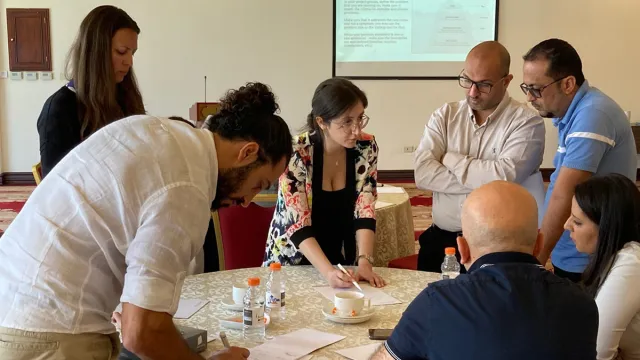
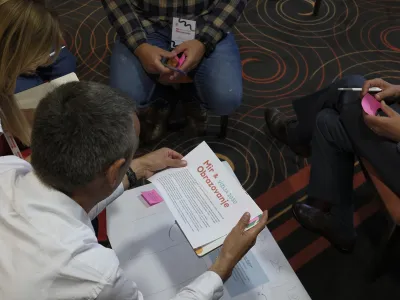
By means of design thinking the participants analyzed the context of their projects, professionally supported by trainer Cynthia Kreidy. -
Image

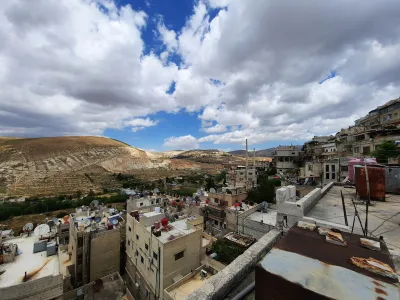
The current impact of climate change on local communities and how this situation might be exacerbated in coming years was presented by one of the project teams from Lebanon. -
Image

Room for discussion and exchange was also provided outside of the conference room. -
Image
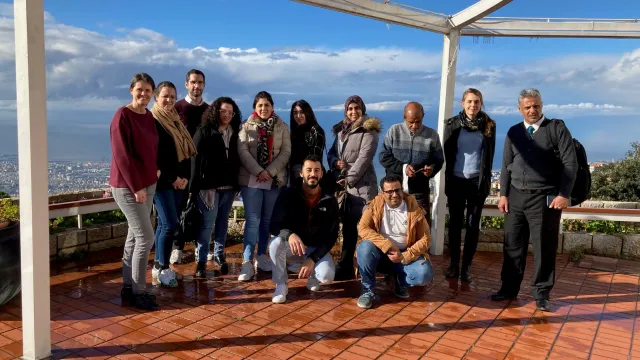
In January 2023, the supported project teams met again, this time in Beirut. -
Image

The teams presented their progress and challenges during the last months to the other teams. -
Image
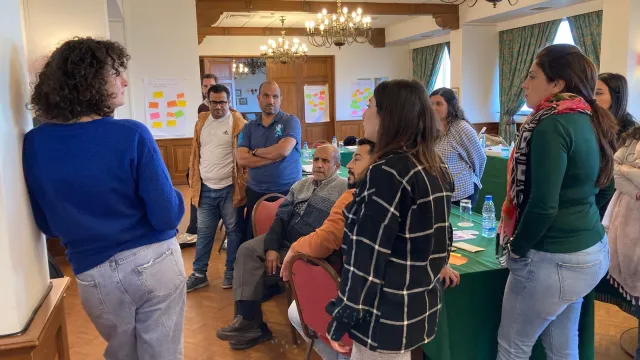
The workshop created a space for intense discussions and collegial advice. -
Image

And of course there were fun moments! -
Image

After the workshop, a regional conference took place, organized by the Arab Reform Initiative, where the projects teams had the opportunity to present their work. -
Image
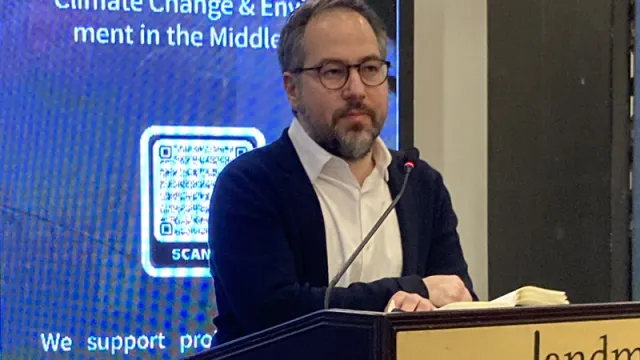
In 2024, the Arab Reform Initiative and the Robert Bosch Stiftung again invited academics and practitioners to a regional conference. Nadim Houry, Director of the Arab Reform Initiative, welcomes the participants on behalf of both organizations in Amman. -
Image
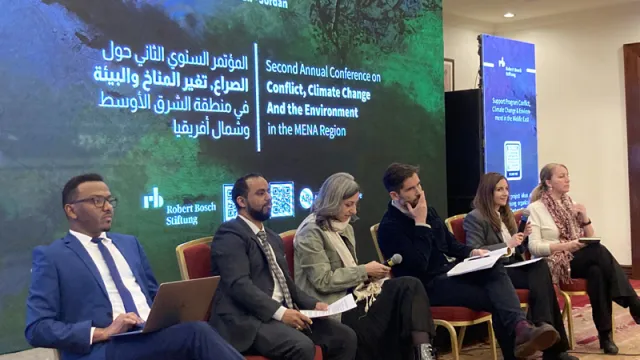
Current challenges relating to the nexus of conflicts, climate and environment were discussed in various panel discussions. -
Image
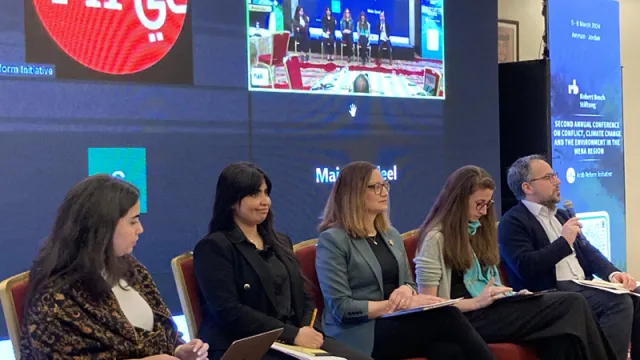
The conference was held in hybrid form to enable people from the entire region and beyond to take part.
About the Project
Climate change has far-reaching impacts on the West Asia. Experts believe that the region’s future will be dramatically affected by changing climate conditions and extreme weather events, the scarcity of natural resources and ongoing environmental pollution caused by humans. Existing lines of conflict will be further exacerbated by these dynamics. At the same time, conflicts will result in long-term environmental damage, which is already evident in the region. Nevertheless, the effects on the environment and climate often do not play a role in peace work.
This program focuses in particular on local actors and locally-led approaches that tackle the challenges presented with comprehensive and sustainable approaches. The Robert Bosch Stiftung implements the various components of the program together with its partner organization, the Arab Reform Initiative.
Why are we running this project?
The interplay between conflict and climate change has multiple impacts on different areas, from food and water sovereignty to migration, public health and on different population groups such as minorities or women. It is therefore important for us to create space for exchange between different actors, practitioners and scholars working at the local, regional, and international level. This is the only way to break down silos and build broad networks and coalitions to strengthen local actors in the long term.
What are our goals?
The intersection of conflict, climate change and environmental change is increasingly on the agenda of international politics, which is why we want to give more space to the needs and demands of local voices in order to sensitize actors to the effects of the so-called nexus at the local level.
We want to promote exchange and joint learning between organizations and individuals working on similar challenges, giving them time to advise each other and transfer knowledge. We are convinced that this will improve the work of local actors and that we can make a contribution to regional networking. This will also give more visibility to best practices and toolkits developed at the local level.
As one of the organizing institutions of this program, we would like to learn from our partners and incorporate their expertise into the further development of the program. Together with local partners, we would like to better understand how we can make a contribution as a funding institution so that we can support the work of our partners on the ground in a meaningful way. In order to meet the real needs on the ground, the activities, projects, and initiatives are largely designed and implemented by our local partners.
How does the program work?
The program consists of different components:
- In January 2023, March 2024 and June 2026 conferences on the topic of Conflict, Climate, and Environment in West Asia and North Africa that brought together experts and practitioners from the region, took place. Since 2024, the conferences were held in hybrid form to allow for greater participation.
- In March 2025, the publication "Participatory Approaches to Conflict, Climate Change and Environment. Case Studies from the Middle East and North Africa" was published, analyzing the implementation of participatory approaches in seven countries in the region, particularly with regard to the potential for a better understanding of their implications for human security.
- Between 2022 and 2024, individual projects were funded to address the challenges of climate change in conflicts in the region at a local level.
From 2022 to 2023, in partnership with the Ettifaq Center for Environmental and Agricultural Consultations, the Medical Mercy Foundation, and the Center for Applied Research in Partnership with the Orient (CAPRO) in collaboration with communities and stakeholders, a project investigated the link between climate change, environmental pollution from oil extraction, and their impacts on public health, tensions, and social cohesion. In a second step, awareness campaigns, workshops, and recommendations for local and national decision makers were developed and implemented.
Together with the Society for Protecting Nature in Lebanon and the World Conservation Union (ICUN), local actors in Lebanon were trained from 2022 to 2024 to use conflict resolution processes to manage community-level disputes. The project is based on an extension of the traditional Hima concept through incorporating conflict resolution approaches to reduce tensions beween local groups sharing natural resources.
In collaboration with the American University of Technology a waste management strategy was developed for Lebanon from 2022 to 2024, based on the engagement of all local stakeholders. For this, awareness camapigns and training courses were conducted with the involvement of the local population.
In cooperation with the Yemen Policy Center Germany e.V. and the Yemen Polling Center, the interconnections between climate change, water scarcity, and conflict were examined from 2022 to 2023. This involved providing information to local and international actors and organizing dialogues with local stakeholders.
- The activities in the projects are accompanied by regional networking meetings, training and exchange measures in line with the needs of the institutions and individuals involved.
- Public webinars are offered at irregular intervals to shed more light on individual aspects of the so-called nexus.
Who organizes and supports the project?
In this program, the Robert Bosch Stiftung works together with a partner institution:
The Arab Reform Initiative (ARI) is an independent regional think tank that helps to formulate an agenda for democratic change, good governance and social justice in the Arab world.
In 2024, the work of the two institutions was supported by the members of an interdisciplinary working group.
Webinars
Cities after Conflict: How to Rebuild Cities that are Adapted to New Environmental and Climate Challenges
Watch the webinar of June 24th, 2025
Organized by our partner Arab Reform Initiative within the framework of our support program “Conflict, Climate Change and Environment in the Middle East”.
Post-Conflict Syria: Evaluating the Impact of War on the Environment
Watch the webinar of June 23rd, 2025
Organized by our partner Arab Reform Initiative within the framework of our support program “Conflict, Climate Change and Environment in the Middle East”.
Participatory Approaches to Conflict, Climate Change and Environment. Case studies from the Levant
Watch the webinar of March 27th, 2025
Organized by our partner Arab Reform Initiative within the framework of our support program “Conflict, Climate Change and Environment in the Middle East”.
Iraq's Enduring Challenges: Environmental Damage and Public Health in a Post-Conflict Landscape
Watch the webinar of July 16th, 2024
Organized by our partner Arab Reform Initiative within the framework of our support program “Conflict, Climate Change and Environment in the Middle East”.
Documenting the Impact of Armed Conflicts on the Environment in MENA: Public Health Effects
Watch the webinar of July 20th, 2023
Organized by our partner Arab Reform Initiative within the framework of our support program “Conflict, Climate Change and Environment in the Middle East”.
Documenting the Impact of Armed Conflicts on the Environment in the Middle East: Filling the Gaps
Watch the webinar of November 29th, 2022
Organized by our partner Arab Reform Initiative within the framework of our support program “Conflict, Climate Change and Environment in the Middle East”.
Your contacts

Irene Weinz
Senior Expert
![[DE Copy] Klimamitbestimmung_ cc Sarah Sakotic-Sondermann_800x600.png](/sites/default/files/styles/bosch_4d3_medium/public/images/media/2025-05/Klimamitbestimmung_%20cc%20Sarah%20Sakotic-Sondermann_800x600.png.webp?h=827069f2&itok=69K7dfNw)
![[DE Copy] Wasser Boden Agroforst](/sites/default/files/styles/bosch_4d3_medium/public/images/media/2025-02/800x600.png.webp?h=827069f2&itok=Zv8KJMPU)
![[DE Copy] Weaving_Lab_Projektseite_800x600](/sites/default/files/styles/bosch_4d3_medium/public/images/media/2023-12/Weaving_Lab_Projektseite_Antonio%20Garc%C3%ADa%20Guerrero%20800x600.jpg.webp?h=827069f2&itok=3d18Gte4)
![[DE Copy] Youth Negotiators Programme_Projektseite_800x600](/sites/default/files/styles/bosch_4d3_medium/public/images/media/2023-11/Youth%20Negotiators%20Academy_800x600.jpg.webp?h=827069f2&itok=jWspkrqW)
![[DE Copy] Marburg_Rural Gatherin_800x600](/sites/default/files/styles/bosch_4d3_medium/public/images/media/2023-11/03_BauernhofClemensGabriel_quer.jpg.webp?h=827069f2&itok=lQmJqRdO)
![[DE Copy] Zukunft_aufgetischt_800x600](/sites/default/files/styles/bosch_4d3_medium/public/images/media/2023-12/Zukunft_aufgetischt_800x600.png.webp?h=827069f2&itok=x3mOGabD)