![[DE Copy] Niger_COP27-HEADER](/sites/default/files/styles/bosch_16d9_medium/public/images/media/2022-10/HEADER_RBS0753.jpg.webp?h=36b29cc6&itok=zQz0ObE8)
On the first day of our journey to the municipality of Illéla, we visit the village of Kiré Kafada, nestled in an abandoned rocky valley in central Niger. Here, members of three ethnic groups, the Tuareg, Peul, and Hausa, are working together to restore their land. As we sit down with them on the ground, they tell us how proud they are of what they have achieved. “Let us first ask for blessings,” one community elder says, inviting us to raise our hands in prayer, a sign of the deep spiritual bond between the people and their land.
Abdou Degi, 82, one of the village elders, explains why their ancestors once chose this place as a settlement. “This area was a forest so dense that we would not even notice when a cow gave birth to a calf,” he says. “Forty years ago, this valley was covered in trees all the way up the hillside,” recalls farmer Ibrahim Abdoulaye. “It was difficult to clear plots for cotton or sweet potatoes.” Abdoul-Aziz Guidan Karo, 44, adds: “The valley was also a refuge for wild animals such as elephants and hyenas.”
Throughout our journey, we hear stories of a lush, green past, a time when there were almost too many trees. Looking around today, that is hard to believe.
The Right to a Healthy Environment
Temperatures in the Sahel are rising 1.5 times faster than the global average. Already today, vast stretches of Niger’s territory consist of barren, infertile land. Every year, another 100,000 hectares suitable for farming or grazing are lost to erosion and land degradation, a process in which soil quality deteriorates to the point where nothing can grow. At the same time, 85 percent of Niger’s population depends on agriculture for their livelihoods and is therefore especially vulnerable to the impacts of climate change, including droughts, floods, wildfires, and desertification.
In 2015, the Republic of Niger committed, as part of the African Forest Landscape Restoration Initiative (AFR100), to restoring 3.2 million hectares of degraded land by 2029. The country’s commitment is also reflected in Article 34 of Niger’s Constitution, which has stated since 2010: “Every person has the right to a healthy environment.”
![[DE Copy] COP27-Niger_Degradierte Flächen](/sites/default/files/styles/bosch_original_medium/public/images/media/2022-10/3-2_RBS0195.jpg.webp?itok=LpUF4Lur)
![[DE Copy] COP27-Niger_Women](/sites/default/files/styles/bosch_original_medium/public/images/media/2022-10/3-2_RBS0184.jpg.webp?itok=k9LGB1HJ)
Over the past several years, the World Resources Institute (WRI), a partner of the Robert Bosch Stiftung, has worked with Niger’s Ministry of Environment and its Department of Water and Forests to develop an action plan for the Illéla region. The goal is to increase agricultural productivity and mitigate the effects of climate change through adaptation strategies. A key element of this approach is ensuring that land restoration efforts take into account the knowledge and needs of local communities.
To understand how this initiative is changing the lives of people in the region, we, a reporting team commissioned by the Robert Bosch Stiftung, traveled to southwestern Niger.
Illéla lies nearly 500 kilometers northeast of the capital, Niamey. By the time the Ministry of Environment’s jeep convoy arrives in the provincial city of Tahoua after a ten-hour journey over rough roads, dusk has already swallowed the landscape.
The next morning, an endless expanse of rolling hills stretches before us in shades of yellow, ocher, and orange. Yet beneath this apparent uniformity lie distinct ecosystems that local communities have traditionally used in very different ways. There are the plateaus, where livestock graze but increasingly struggle to find food as rainfall becomes less reliable. There are the slopes, which are particularly vulnerable to erosion but are nonetheless being cultivated more and more for agriculture. And there are the valleys, where rivers and ponds form during the rainy season, supporting the cultivation of sorghum, maize, peanuts, and vegetables, while trees grow to heights of five to ten meters.
“Alongside land degradation, demographic growth and rapidly expanding livestock herds are our greatest challenges,” says Professor Tougiani Abasse of the National Institute of Agricultural Research of Niger and a scientific advisor to WRI. The population of Illéla is projected to nearly triple, growing from 170,000 in 2017 to almost 500,000 by 2045. As a result, increasingly unsuitable land is being brought under cultivation, putting it at risk of degradation.
The growing demand for firewood and timber is driving further deforestation. As vegetation becomes thinner, the soil’s natural ability to regenerate declines, accelerating the cycle of land degradation.
![[DE Copy] COP27-Niger-Mairie](/sites/default/files/styles/bosch_original_medium/public/images/media/2022-10/3-2_RBS0172.jpg.webp?itok=fF3CqmJl)
![[DE Copy] COP27_Niger-Workshops](/sites/default/files/styles/bosch_original_medium/public/images/media/2022-10/3-2_RBS0410.jpg.webp?itok=vuqoRDVP)
“I have lived in this region for ten years, and during that time we have had only one truly satisfactory harvest,” says Salifou Garba, Illéla’s Regional Director for the Environment, who is known locally as “Colonel Papa” and also serves as our Hausa interpreter.
Local Ownership and Indigenous Knowledge Are Essential for Lasting Change
For decades, the Republic of Niger has ranked among the countries with the lowest levels of food security in the world and consistently places at the bottom of the Human Development Index. Over the years, Niger has seen many aid and development projects, not all of them successful.
“International organizations often arrive with standardized solutions and leave again once the project is completed,” says Colonel Papa. The action plan for Illéla, developed by WRI and the Ministry of Environment, notes: “Top-down approaches often fail to create a sense of ownership among local communities, overlook local knowledge, and tend not to be sustainable.”
To avoid repeating these mistakes, the Illéla initiative involved local administrative authorities, municipal and traditional leaders, and community members from the very beginning. Workshops were held with both men and women to gain a better understanding of local conditions, share knowledge, develop a common vision, and drive the process forward together.
“The first step is to raise awareness of the problem,” says Professor Abasse, “so that people understand the phenomenon of land degradation and how it is linked to climate change.”
![[DE Copy] COP27_Niger-Ghaya Ben Mbarek Gruppe](/sites/default/files/styles/bosch_original_medium/public/images/media/2022-10/3-2_RBS0675_0.jpg.webp?itok=xE4qVEy-)
The soil on the plateaus and hillsides is dry and hard, almost like ochre-colored asphalt. We accompany a group of workers, many of them women and young people, as they use hoes and other tools to break through the hardened crust of the earth and dig so-called half-moons: curved basins about 20 inches deep and 13 to 16 feet long that capture water and nutrients, helping to restore soil fertility. This method of land restoration has deep roots in local tradition, Colonel Papa explains. “Long ago, people here dug small pits to collect water before planting millet.”
The work is physically demanding. “For months, we worked together from morning to evening, men and women alike,” says Hadizatou Tanko, a farmer from Kiré Kafada. Restoring the higher-lying areas also helps protect the valley’s riverbeds and ponds from silting up. New plantings and sustainable wood harvesting practices, which leave shoots in the soil so they can regenerate, further support the recovery. Just five years after restoration efforts began, trees are once again growing in the river valley. “The fact that our children can once again gather gum arabic here is thanks to the entire community,” says Hadizatou Tanko.
As it turns out, the shared work has done more than restore the landscape. It has also fostered a renewed sense of belonging. “The work is changing people’s relationship with their land,” says Professor Abasse. With their own hands, community members clear stones from the fields and use them to create planting basins filled with manure and compost, where plant species that had long disappeared are now beginning to grow again. “The return of these species gives people a sense of control,” Abasse says.
![[DE Copy] COP27_Niger-Reportage Niger](/sites/default/files/styles/bosch_original_medium/public/images/media/2022-10/3-2_RBS0768.jpg.webp?itok=2zrFo3TD)
![[DE Copy] COP27_Niger-Erde](/sites/default/files/styles/bosch_original_medium/public/images/media/2022-10/3-2_RBS0748.jpg.webp?itok=zJXsLBQa)
After all the hard work, the results are assessed to determine whether the effort has paid off. The stories shared by villagers in Illéla are encouraging, but WRI has also conducted a cost-benefit analysis to examine how the measures have changed people’s lives and livelihoods. On restored land, millet yields increased more than fivefold compared with untreated land. Sorghum and peanut yields showed similar gains. Wildlife also returned to these areas, while the availability of wood and animal feed increased.
What Can Local Communities Teach the Global COP27 Conference?
But the picture is not entirely rosy, or rather, entirely green. Not all of the treated land could be successfully restored. And WRI’s analysis makes one point very clear: “The restoration goals of the municipality of Illéla will be difficult to achieve unless sufficient financial resources are made available to scale up best practices, that is, to replicate them in other regions.” The experience of Illéla highlights a challenge that extends far beyond Niger. Local communities can restore degraded land and build resilience to climate change, but lasting impact requires sustained investment. Without adequate funding, even the most successful restoration efforts remain limited in scale and unable to reach the many communities facing similar challenges.
At the COP27 climate conference in Sharm El-Sheikh in November 2022, participating countries were set to review the progress of the AFR100 initiative. The interim assessment was mixed. On the one hand, large areas of degraded land across Sub-Saharan Africa had been restored. On the other, many regions continued to face a lack of financial resources, and it was not always fully transparent how and where funding was being allocated.
As the project moves into its second phase, a key focus will be on establishing funding mechanisms that channel resources directly to local communities, such as those in Illéla. The underlying conviction is that large-scale restoration efforts can succeed only if the people most affected are empowered to decide how resources should be used in the fight against the climate crisis.
![[DE Copy] Frauen im Niger](/sites/default/files/styles/bosch_original_medium/public/images/media/2022-10/_RBS0384_0.jpg.webp?itok=IjgMWEev)
Beneath the shade of a tree, residents gather with Professor Abasse and Colonel Papa to discuss the state of their community and its land. This exchange is both part of everyday life and a core element of the project’s approach. Landowners and laborers, representatives of government agencies and traditional authorities, women and men, young and old all come together to discuss the restoration of their land. Community members participate in decision-making and monitor the process themselves. The committee is expected to collaborate with similar groups in other municipalities at the regional and national levels, sharing experiences from the restoration process and developing a practical toolkit of lessons learned and effective approaches.
The fight against land degradation is transforming not only the landscape and the environment, but also the local economy and the way people live together. Those who can no longer make a living from their own land are now able to regain a measure of self-reliance through wages earned from restoration work. “We have thrown ourselves into this work heart and soul because it brings us so many benefits,” says Mariama Aboubacar, 65. “We receive a regular payment every three weeks.” But she speaks about more than income and livelihood. She also reflects on the bigger picture: “We are truly pleased with how our land has changed. And that is the greatest source of motivation for all of us.”
At a Glance
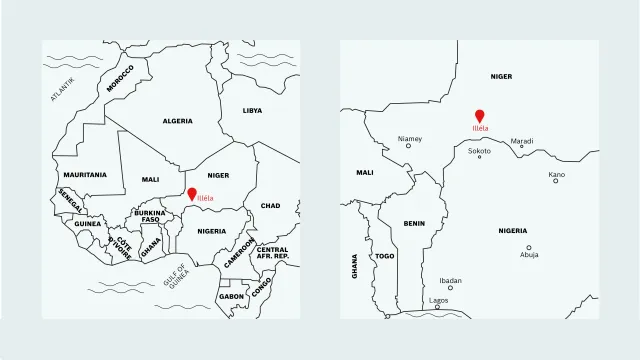
West Africa
Illéla is located in southwestern Niger. It took the Robert Bosch Stiftung reporting team more than ten hours to reach the town from the capital, Niamey, traveling in two Ministry of Environment jeeps. Spring is the hottest season of the year, and daytime temperatures rarely dropped below 45 degrees Celsius.
African Forest Landscape Restoration Initiative
Restoring forest landscapes, which serve as vital carbon sinks for our planet, is essential to both combating climate change and strengthening climate resilience. Political commitment to this issue is growing: the African Forest Landscape Restoration Initiative (AFR100) brings together 32 countries that have pledged to restore a total of 128 million hectares of degraded land by 2030, an area more than three times the size of Germany. The challenge now is to turn these national commitments into tangible restoration successes on the ground. We have supported the World Resources Institute (WRI), one of AFR100’s principal partners, in advancing restoration efforts in two key regions, Makueni in Kenya and Illéla in Niger, while reimagining restoration through the lens of equity and justice.



![[DE Copy] janineoswaldfotografie_RBS_final-800x600.jpg](/sites/default/files/styles/bosch_3d2_small/public/images/media/2026-05/janineoswaldfotografie_RBS_final-800x600.jpg.webp?h=827069f2&itok=RxPGzY-1)