Image

Skilled workers for the future
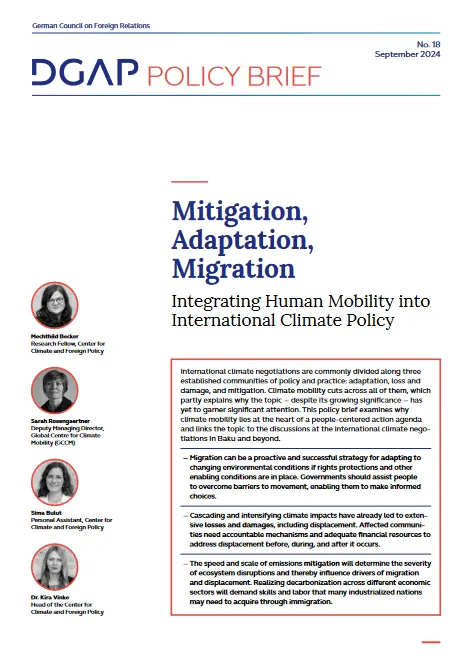
In view of the current shortage of skilled workers and the urgent challenges of climate change, the immigration of skilled workers with “green skills” from climate-vulnerable countries will be crucial over the next 20 years. In this brochure, our expert Hannes Einsporn and our partner the German Council on Foreign Relations (DGAP) describe concrete measures that the next German government can take to harness the potential of skilled labor immigration and shape a sustainable future for Germany and the countries of origin. In German language.
Deutsche Gesellschaft für Auswärtige Politik (DGAP)

![[DE Copy] 260502_IDMC_GRID26_web-1.jpg](/sites/default/files/styles/bosch_4d3_medium/public/images/media/2026-05/260502_IDMC_GRID26_web-1.jpg.webp?h=8c302e12&itok=Az0SHZfo)


![[DE Copy] GemeinsamVoran-Cover_210 x 297.png](/sites/default/files/styles/bosch_4d3_medium/public/images/media/2025-06/GemeinsamVoran-Cover_210%20x%20297.png.webp?h=6a9e38f6&itok=PSqKuGSE)


![[DE Copy] Klimamitbestimmung_ cc Sarah Sakotic-Sondermann_800x600.png](/sites/default/files/styles/bosch_4d3_medium/public/images/media/2025-05/Klimamitbestimmung_%20cc%20Sarah%20Sakotic-Sondermann_800x600.png.webp?h=827069f2&itok=69K7dfNw)
![[DE Copy] Weaving_Lab_Projektseite_800x600](/sites/default/files/styles/bosch_4d3_medium/public/images/media/2023-12/Weaving_Lab_Projektseite_Antonio%20Garc%C3%ADa%20Guerrero%20800x600.jpg.webp?h=827069f2&itok=3d18Gte4)
![[DE Copy] Youth Negotiators Programme_Projektseite_800x600](/sites/default/files/styles/bosch_4d3_medium/public/images/media/2023-11/Youth%20Negotiators%20Academy_800x600.jpg.webp?h=827069f2&itok=jWspkrqW)
![[DE Copy] Marburg_Rural Gatherin_800x600](/sites/default/files/styles/bosch_4d3_medium/public/images/media/2023-11/03_BauernhofClemensGabriel_quer.jpg.webp?h=827069f2&itok=lQmJqRdO)
![[DE Copy] Zukunft_aufgetischt_800x600](/sites/default/files/styles/bosch_4d3_medium/public/images/media/2023-12/Zukunft_aufgetischt_800x600.png.webp?h=827069f2&itok=x3mOGabD)

![[DE Copy] Agora Agrar land use study](/sites/default/files/styles/bosch_original_medium/public/images/media/2024-09/AGR_Land-use-study_240903_Page_001_0.png.webp?itok=R0lJhWLv)
![[DE Copy] Climate-Landrights2025-cover.png](/sites/default/files/styles/bosch_4d3_medium/public/images/media/2025-05/Climate-Landrights2025-cover.png.webp?h=0a1a5052&itok=hrW8i-NA)

![[DE Copy] ecologic_Abschlussbericht_Cover](/sites/default/files/styles/bosch_original_medium/public/images/media/2024-06/CEE_agrifood_report_final_Page_001.jpg.webp?itok=zTozQVPk)